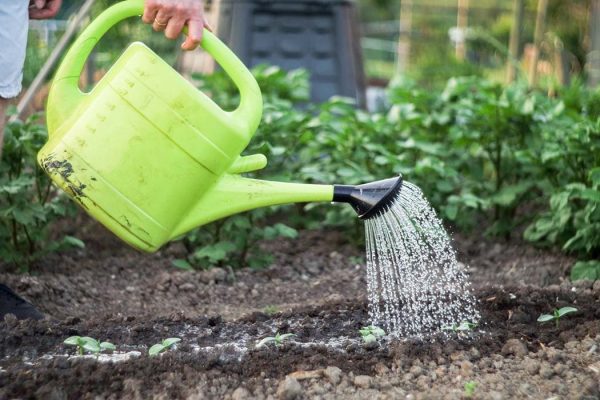
What’s the big deal about watering plants in your garden? Simply pour it on right?……….wrong! Plant watering is achieved in just about as many ways as you can imagine. Without a doubt, how and when you water to the roots of your plants, is an important topic. It certainly can be done wrong or in a less-than-ideal way. In your quest for the perfect garden, understanding and applying the right watering techniques will bear fruit…or flowers or vegetables, or………..
Why bother to read and learn about proper watering techniques? There are two big reasons. First, water applied at the wrong time can promote the growth of plant diseases. Second, the amount of water getting to the plant on a constant basis affects growth in several ways. In addition, your watering efforts can be wasted or inefficient, and that affects your wallet. Ideally, your garden or lawn soil should have a consistent amount of moisture at all times.
I bet you never thought a simple subject like water could be the source of so much information and learning, did you?
Did you Know? Rain falls at about 19 miles per hour.
Thought for the Day: If you want to see a rainbow, you have to put up with the rain.
Do you know how to properly water plants!? Read on and see………
Proper Frequency for Watering Plants
How frequently should you irrigate your garden? The answer to this question varies from plant to plant. For example, a cactus in the desert needs to take a drink of water once a month or less. On the other hand, a water lily or rice grows in water. These are obvious examples at the extreme ends of the spectrum. Most plants fall pretty close to the middle.
For most home garden plants, the answer is …… whenever the soil begins to dry out. The general rule of thumb is to keep your soil moist, not wet, and not dry.
The frequency of watering is also a function of the type of soil you have. Heavy clay soils have difficulty absorbing water. But, once it does, it retains it for a long time. A good watering of clay soil will last several days, even in hot, dry weather. Sandy soils, on the other hand, do not retain water. It flows right through, as there is little structure to hold it. Watering sandy soils every couple of days during hot or dry spells is sometimes required.
Adjust your watering plan to provide moist soil conditions on a regular, consistent basis. Not wet and soggy, and not dry. And not dry one week and wet the next. Water lightly and frequently for sandy soils, and less frequently for clay soils. Don’t water every day. Daily watering results in shallow roots. Your plant will learn to depend on this water and will only develop shallow roots. Then, you will be a slave to your garden (if you are not already), and you will be afraid to leave for more than a day on vacation. Daily watering also affects your pocketbook
Garden Watering Tip:
Allow the top of the soil to dry between watering. This is important, as plant diseases may harbor in the soil, and tends to concentrate in the top layer. Drying the soil out between watering, especially during humid weather, will help to keep disease problems to a minimum.
Watering Plants with the Right Amount of Water
As we’ve already said, plants like to have moist, but not wet soil conditions. This enables the water to break down chemical and mineral components in the soil into a small enough size to be absorbed through the root system. Check the soil below the surface. Turn it over with a spade and see if it is just dry on top, or if your watering technique is only reaching down a few inches.
If you know about your water table levels, make sure the soil is moist down to the water table. You also want to encourage your roots to develop deeply and tap into water available at lower levels.
As a rule of thumb, apply one inch per week. This includes rainwater and the water you add. Adjust it accordingly if your plant needs more or less.
Importantly, overwatering results in washing valuable nutrients and minerals from the soil. You can spend a lot of money on fertilizer and then wash it quickly through the soil with little benefit to the plant. This is especially true with liquid fertilizers.
When Watering Plants, Timing is Everything
A lot of gardeners do not know that there is a “When to” and “When not to” water your plants. We strongly urge you not to water in the early evening, or at night. Plant diseases thrive in hot, humid weather. They also prefer the darkness of night. These three combined are a perfect breeding ground. We strongly recommend you avoid watering at night, as you will only help create the perfect conditions for plant disease.
Early morning is best. The leaves will dry in the early morning sun, yet evaporation will be lower. Mid-day is also fine, but evaporation can be high.
Other Plant Watering Issues
Many people have asked about the quality of water as it might affect your plant. The minerals, chemicals (good and bad), and even pollutants in water can be absorbed by your plant. If the water contains pollutants, your plant can absorb some portion of it. If it is a chemical harmful to plant growth, then the plant will suffer. Too high a concentration and it can die. Recognizing that the plant can absorb chemicals from the water, those same chemicals make it’s way to the fruit and vegetables you and your family ultimately eat.
The focus of this issue usually comes into question when a gardener is considering using water from a creek, pond, or river. If you are unsure of the water quality, have it tested or look for alternatives. Small creeks and ponds in residential or commercial areas are of the greatest concern. They are less able to dilute pollutants. Insecticides, weed killers, fungicides, and manufacturing waste all can leach into small creeks and streams. Individuals have also been known to discard a variety of waste products and chemicals despite laws and awareness of the environmental impact. Municipal water, which most of us use is certainly safe. Well water should be, too. Of course, you should test well water regularly for your own consumption.
The high concentration of chlorine in your pool water can hurt your plants in large doses. We do not recommend you use the water when backflushing, especially for fruit and vegetable plants.