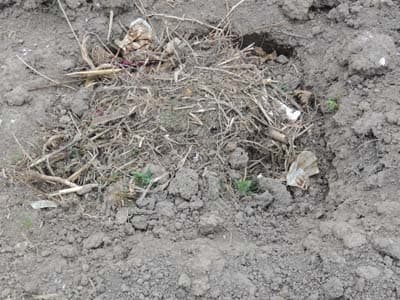
A compost “Honey Hole” is simply raw compost materials that are buried underneath the spot where you will grow plants. It becomes a sweet spot in your garden where plant roots can draw a wealth of rich minerals and nutrients. Also, you can bury partial, or fully decomposed materials. Burying raw compost in the Fall allows it to decompose over the long winter months. Then, it feeds your plants all summer long.
The concept of a compost honey hole is simple: Bury a mixture of compost where you will place a plant(s). You can add manure to this nutrient-rich mixture, too. As the plant’s roots grow in search of moisture and nutrients, it reaches down to the rich compost and manure, fueling the plant’s growth.
Note: If you use raw compost, bury it in the Fall, or early in the spring. It will decompose underground and be ready to feed your plants when the roots reach the material.
Using this composting technique attracts earthworms. The earthworms will go to work, feeding on the materials buried in the honey hole. They will leave behind, rich worm castings. Also see: Vermicomposting
And, yet another benefit is burying raw compost keeps a wide array of critters away from an above-ground compost pile.
How to Make a Composting Honey Hole
Dig a hole in the garden about two feet deep. Burying compost is best done in the Fall. Bury raw, un-decomposed compost materials. You can add manure too. Put compostable materials into the hole in layers. Include layers of garden soil. The top layer should be 3-6 inches of garden soil. Do not compact down the hole.
To mix or not to mix – If you use the layered approach above, mixing the materials is not necessary. If you feel better about mixing the materials first, go ahead and give it a few turns. There is no right or wrong way to mix materials. A pitchfork is helpful, to turn and mix the compost materials.
The finished Honey Hole should be slightly mounded. The materials will settle over time. This also allows excess water to drain away, too.
The decomposition process gradually takes place over the winter months. Your garden is ready to plant over the compost, as soon as spring arrives.
If you bury compost in the spring, the materials should be partially, or completely decomposed.
Additionally, this technique keeps varmints from overwintering in the compost pile.
A very similar technique is a Compost Honey Trench. The difference is burying compost in a long trench versus a hole. This technique works great when planting rows of crops.